
Arsenal begin the 2026/27 Premier League season as defending champions, and continuity is one of their biggest advantages as the season gets underway.
Mikel Arteta remains in place after guiding Arsenal to 85 points and their first league title since 2004. Around them, the picture has changed considerably. Manchester City are beginning life after Pep Guardiola. Liverpool have changed manager after falling from champions to fifth. Chelsea and Tottenham are starting again under new head coaches, and nine Premier League clubs enter the season with a different manager from the one who started 2025/26.
That makes this a difficult season to judge from reputation alone.
The numbers from last season point clearly towards Arsenal and Manchester City as the strongest starting positions, but they also highlight several clubs whose league finish did not fully match their underlying performance. At the other end, three promoted teams arrive with very different historical survival profiles, while at least one established Premier League side carries some uncomfortable warning signs.
This preview uses Dedicated Betting's domestic league database to look at the title race, the teams most capable of moving up, and the clubs most vulnerable to being pulled towards the bottom.
Explore the latest Premier League stats and drill into team data →
Can Arsenal Defend the Premier League Title?
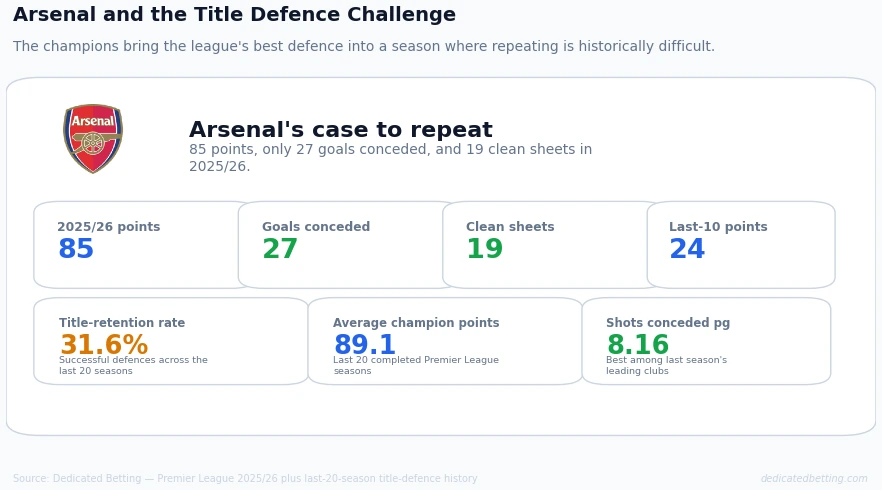
Arsenal's title was built on a level of defensive control nobody else in the league matched.
They conceded only 27 goals in 38 matches, eight fewer than Manchester City, and kept 19 clean sheets. Opponents managed only 8.16 shots per game against them, comfortably the lowest figure among the leading sides. Arsenal were also strong in both environments: 2.47 points per game at home and 2.00 away.
Their finish was strong too. Arsenal collected 24 points from their final 10 matches, conceding only six goals during that run.
Those numbers make them a perfectly credible favourite to repeat. The more interesting question is whether 2025/26 was a title-winning level they can simply reproduce.
Across the last 20 completed Premier League seasons, champions have averaged 89.1 points. Arsenal won last season with 85. That does not diminish the achievement, but it does suggest the bar may rise if City, United or Liverpool improve.
History is also less friendly to defending champions than reputation sometimes suggests. Of the 19 title-defence opportunities across those 20 seasons, only six ended with the champions retaining the trophy: 31.6%. Defending champions also lost an average of 12.5 points in the following campaign.
Title benchmark: The average Premier League champion across the last 20 seasons has finished on 89.1 points. Arsenal won 2025/26 with 85.
Arsenal therefore enter 2026/27 with the league's strongest recent defensive profile and the greatest managerial continuity among the traditional leading clubs, but retaining the title is historically a much harder task than winning it once.
William Saliba's fitness is particularly important in that context. Arsenal's margin for error is much smaller if the defence that separated them from City last season is weakened for any extended period.
Who Can Actually Catch Arsenal?
Manchester City remain the clearest starting point.
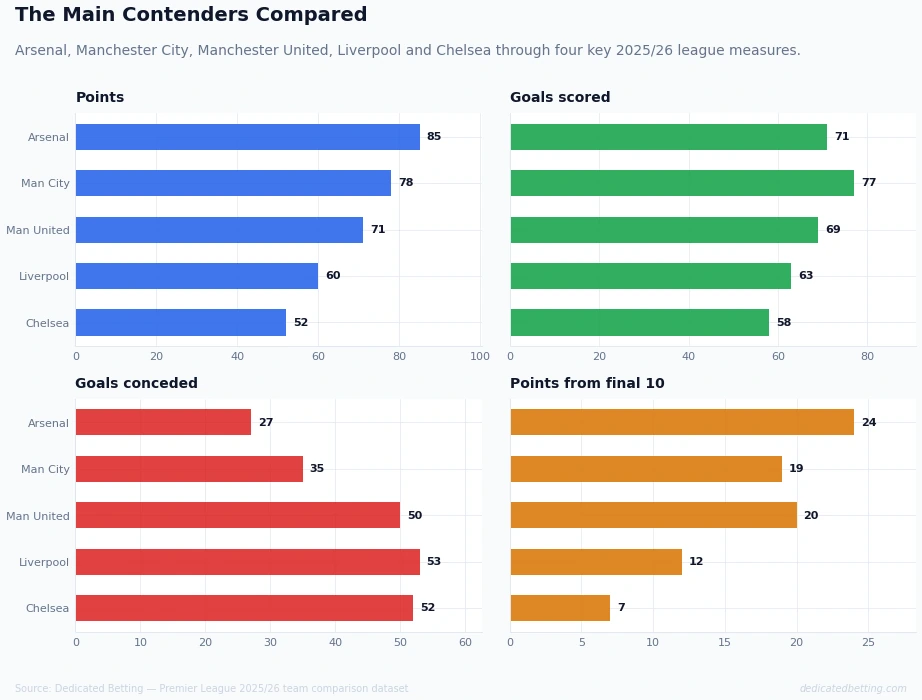
They finished seven points behind Arsenal last season but scored a league-high 77 goals, six more than the champions. City also produced more shots (595 vs 552) and more shots on target (205 vs 186). The gap was at the other end: City conceded 35 goals to Arsenal's 27 and allowed 9.71 shots per match compared with Arsenal's 8.16.
That would normally point towards refinement rather than reconstruction. The complication is obvious: Guardiola has gone after a decade in charge, and Enzo Maresca inherits a team whose football has been shaped around one manager for longer than any of their current title rivals.
Manchester United: the strongest recent momentum
Manchester United's third-place finish was backed by an excellent run under Michael Carrick.
United ended 2025/26 with 20 points from their final 10 matches, second only to Arsenal among the leading clubs. Across Carrick's final 17 league games they took 39 points, turning a difficult season into a 71-point third-place finish.
The concern is defensive. United conceded 50 goals, almost double Arsenal's total, and kept only eight clean sheets. They also allowed 11.61 shots per game.
The attacking volume was much stronger: United actually recorded 596 shots, the highest total among the main contenders in our dataset, and 216 on target. If the defensive side improves without sacrificing that attacking output, their 2025/26 recovery begins to look more sustainable.
Liverpool: better underlying numbers than fifth place suggests
Liverpool are harder to read.
The raw season was poor by their standards: 60 points, fifth place, 53 goals conceded, and only 12 points from their final 10 matches. Mohamed Salah has also gone, while Andoni Iraola replaces Arne Slot.
Yet Liverpool still generated 588 shots, almost identical to City's 595. Their attacking volume was therefore much closer to a title contender than their league position suggests.
The problem was turning that volume into control. Liverpool scored 63 goals but conceded 53, and their shot accuracy of 29.8% was notably below Arsenal, City and United.
That makes them one of the most volatile teams at the top of the league. There is enough underlying attacking quality for a major rebound, but more has changed around them than at Arsenal.
Aston Villa: established, but now with a different challenge
Aston Villa finished fourth with 65 points and enter the Champions League as Europa League winners.
Their 2025/26 league numbers were solid rather than dominant: 56 goals scored, 49 conceded and a +7 goal difference. They also took only 14 points from their final 10 league matches.
Villa have earned their place among the leading group, but balancing another European campaign with the domestic league is a different test from simply proving they belong near the top four.
Chelsea: the wildcard
Chelsea's tenth-place finish is one of the least useful league positions to take at face value.
They ended with 52 points and collected only seven from their final 10 games, but their broader numbers were not those of a normal tenth-place side. Chelsea allowed fewer shots than United or Liverpool and finished with a positive goal difference despite a season that never settled.
Now they have Xabi Alonso, major squad investment and no European football.
That combination makes Chelsea one of the hardest teams to price purely from last season's table. They are not the most obvious title challenger, but they may have more room to improve their league position than anyone above the relegation fight.
Which Teams Could Make the Biggest Jump?
Not every interesting team needs to be a title contender.
Some of the biggest changes in 2026/27 could come from clubs starting much further down the table.
Chelsea
Chelsea are the obvious candidate because tenth is such a low base.
They scored 58 goals last season, only five fewer than Liverpool, and their defensive shot numbers were stronger than their final position suggests. The combination of a new manager, a stronger squad and no European schedule creates a very different environment from 2025/26.
Moving from tenth into the European places would be a large rise without requiring Chelsea to become a genuine title challenger.
Tottenham
Tottenham finished 17th with 41 points for the second consecutive season, a position that makes almost any discussion of improvement sound dramatic.
The underlying numbers were poor, but not uniformly relegation-level. Spurs scored 48 goals, averaged 11.47 shots per game and finished only three goals worse than Nottingham Forest on goal difference.
Their biggest problem was home performance. Tottenham averaged only 0.79 points per game at home, compared with 1.37 away. A club with their resources cannot sustainably treat its own stadium as the more difficult environment.
Roberto De Zerbi now takes over without European football, and the squad has been reshaped again. There is still plenty to fix, but even a return towards mid-table would represent one of the biggest year-on-year rises in the division.
Nottingham Forest
Forest are a different type of candidate.
They finished 16th with 44 points after a season of managerial instability, but their closing form was much stronger: 17 points from the final 10 matches, with 22 goals scored and only 10 conceded.
Oliver Glasner therefore inherits a side whose final league position disguises how well it ended the campaign. That does not automatically make Forest a European challenger, but it does make 16th look like a potentially misleading starting point.
Promoted Clubs: History Says the Route Matters
Coventry City, Ipswich Town and Hull City all arrive from the Championship, but Premier League history does not treat all promotion routes equally.
Across the last 20 completed seasons in our database:
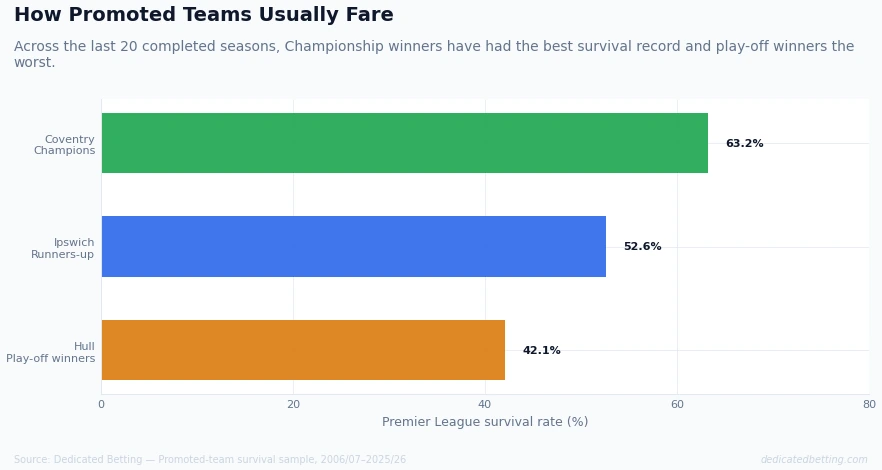
| Promotion route | Promoted teams | Survival rate | Avg PL points | Avg finish |
|---|---|---|---|---|
| Championship champions | 19 | 63.2% | 38.5 | 15.0 |
| Championship runners-up | 19 | 52.6% | 36.8 | 15.6 |
| Play-off promoted | 19 | 42.1% | 33.0 | 16.8 |
That gives each of this season's newcomers a different historical starting point.
Coventry arrive as Championship champions, the route with the strongest survival record in our 20-season sample. Nearly two-thirds of champions promoted to the Premier League stayed up.
Ipswich come up as runners-up. Their historical survival rate is much closer to 50-50.
Hull arrive through the play-offs, the route with the weakest record. Only 42.1% of play-off promoted teams in the sample survived their first Premier League season, and they averaged just 33 points.
None of those percentages predicts what will happen to an individual club. Squad quality, recruitment and how quickly a promoted team adapts matter far more than the route itself. But the long-term difference is large enough to make Hull's starting position the most difficult of the three.
Who Could Be Pulled Into the Relegation Fight?
The traditional 40-point survival target is useful shorthand, but the actual modern benchmark is slightly lower.
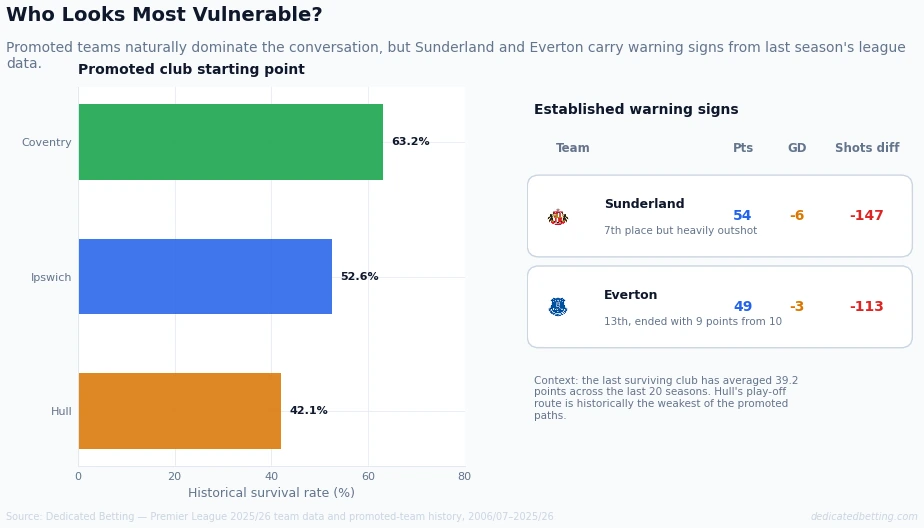
Across the last 20 Premier League seasons, the final surviving club has averaged 39.2 points.
The lowest surviving total in that period was 36, while the highest first-relegated total was 41. So there is no magic number, but a club heading towards the high 30s is usually operating with very little margin for error.
The three promoted sides naturally begin in the conversation, especially Hull given the historical record of play-off winners. The more interesting question is which established Premier League sides could join them.
Sunderland: seventh place hides some warning signs
Sunderland were one of the stories of last season. They finished seventh with 54 points in their first year back in the Premier League and secured European football.
But their underlying domestic numbers were considerably less impressive than the league position.
Sunderland scored only 42 goals, conceded 48 and finished with a -6 goal difference. Opponents outshot them 542 to 395, while Sunderland allowed 14.26 shots per game and generated only 10.39 themselves.
Those numbers do not say Sunderland will be relegated. They do suggest that repeating seventh may require another season of converting difficult match situations unusually well.
The additional European schedule also changes the demands on a squad that was able to focus heavily on the league last season.
Everton: enough warning signs to watch
Everton finished 13th on 49 points, ten above the relegation line, so they are not an obvious crisis candidate.
The shot numbers are worth watching, though. Everton were outshot 533 to 420 across the season and managed only nine points from their final 10 matches. Their home record was also weaker than their away record despite the move to a new stadium.
That is not enough to label Everton a relegation favourite, but it places them closer to the group we would monitor than their ten-point cushion might initially suggest.
Crystal Palace and Fulham look less vulnerable on the data
Crystal Palace finished only 15th, but their defensive profile was much healthier than several teams around them. They kept 12 clean sheets and their shot differential was almost level.
Fulham finished 11th with 52 points. Their away form was poor, but their overall numbers do not currently show the same warning signs as Sunderland.
That distinction matters. A useful relegation preview should not simply list every club that finished in the bottom half.
At this stage, Hull look the most exposed promoted side, Sunderland carry the clearest regression warning among established clubs, and Everton are worth monitoring behind them. Coventry and Ipswich face the normal promoted-team challenge, but their route into the division has historically produced better survival rates than Hull's.
Golden Boot: Is Haaland Still the Obvious Starting Point?
Erling Haaland remains the natural benchmark for the Golden Boot market, but he is not inevitable.
The clearest reminder came in 2024/25, when Haaland scored 22 league goals but still finished third behind Mohamed Salah (29) and Alexander Isak (23). He enters 2026/27 with the chance to win a fourth Golden Boot in five seasons, but recent history shows that even an elite Haaland season can be beaten.
The challengers are less obvious than usual because several leading attacks are changing shape.
João Pedro is one of the more interesting names if Chelsea improve as expected. He scored 15 Premier League goals in 35 appearances last season and should continue to get significant minutes through the middle. Chelsea's lack of European football may also help keep their attacking core fresher across the league campaign.
Morgan Rogers adds another Chelsea angle. He has scored 14 goals in all competitions in each of the last two seasons and now joins a side that has invested heavily in him. His role may not be as direct as Pedro's, but if Alonso uses him centrally for long stretches, his ceiling is considerably higher than a conventional attacking midfielder.
Manchester United have several candidates rather than one obvious focal point. Bryan Mbeumo scored 11 league goals last season after a 20-goal 2024/25 campaign with Brentford, while Matheus Cunha reached 10 despite rarely operating as United's main striker. Mbeumo's stronger recent scoring record and greater likelihood of playing through the middle make him the more obvious Golden Boot outsider of the two.
Further down the market, Dominic Calvert-Lewin is worth noting purely on opportunity. He scored 14 league goals for Leeds last season, started 30 games and generated one of the division's highest expected-goals totals. Fitness has always been the question, but another full season with penalty duties would give him a plausible route into the upper end of the scoring table.
The main obstacle for all of them is still Haaland. None combines his scoring history, central role and expected minutes as cleanly. But the field is deeper than simply "Haaland or nobody", and Chelsea in particular could produce a genuine challenger if their improvement under Alonso is as significant as the wider team section suggests.
Dedicated Betting's 2026/27 Verdict
The league looks more open than Arsenal's seven-point title margin might suggest.
Arsenal start with the strongest case because they combine the league's best defence with managerial continuity. The historical difficulty of retaining the title, and the fact that 85 points sits below the 20-season champion average, prevents them from looking untouchable.
Manchester City remain the clearest challenger. Their attacking numbers were already title-winning quality last season; the question is how quickly the post-Guardiola version of City settles.
Manchester United have the strongest late-season momentum of the challengers, but their defensive record still needs substantial improvement.
Liverpool have enough underlying attacking volume to rebound sharply, although replacing Salah and adapting to Iraola creates more uncertainty than their reputation alone suggests.
Chelsea are our strongest candidate to make a major jump up the table. Tenth place understates some of their underlying numbers, and a season without European football gives Alonso more training time than most of the clubs they are trying to catch.
At the bottom, Hull begin with the weakest historical promotion-route profile. Sunderland are the established side whose 2025/26 league position looks most vulnerable to regression when set against the underlying shot numbers.
The central theme for 2026/27 is therefore not simply whether Arsenal are good enough to win again. They clearly are.
It is whether Arsenal's continuity can survive a season in which almost every major rival is changing around them.
Methodology
Premier League historical benchmarks in this preview use the last 20 completed seasons, 2006/07 to 2025/26. This gives a consistent modern sample rather than using an arbitrary partial history of the competition.
Team performance statistics are drawn from Dedicated Betting's domestic league database and cover the full 2025/26 Premier League season. Cup and European competition matches are not included.
Promotion-route survival analysis tracks clubs promoted from the Championship into the Premier League and whether they remained in the division the following season.
Historical relationships are descriptive rather than predictive. A promotion route, previous points total or shot profile does not determine what a club will do in 2026/27.
View Premier League tables, fixtures, team stats and match analysis →
Related Articles
Championship 2026/27 Preview
The teams chasing promotion, the relegated Premier League clubs trying to bounce back, and the historical numbers behind the Championship season: Championship 2026/27 Preview.
Premier League 2025/26 Season Review
See how Arsenal won the title, which teams over, and underperformed, along with what the full 380-match season revealed: Premier League 2025/26 Season Review.
Football Betting Strategy: What the Data Shows
Understand the true ROI from every simple selection system across 182,000 matches: Football Betting Strategy.