A heavy defeat creates one of football betting's most tempting stories.
The team has been embarrassed. The manager demands a reaction. Supporters expect more effort, and the players have an immediate chance to put things right.
That sounds like a strong reason to expect a bounce back, it does not automatically make the team a good bet.
We analysed 24,688 occasions when a team lost its previous league match by three or more goals, covering 22 European leagues across the 24 completed seasons from 2002/03 to 2025/26. We then measured what happened in the team's next match and whether backing it at closing bookmaker odds made a profit.
Key finding: Teams won 33.3% of their next matches after suffering a heavy defeat, almost exactly in line with the market's 33.8% expectation. Blindly backing every team produced an 8.8% loss on stakes.
Do Teams Bounce Back After a Heavy Defeat?
There is no single definition of a bounce back. A team might respond with a better performance, earn a draw, or simply avoid another heavy loss.
For betting purposes, the clearest test is more direct: did the team win its next league match?
Across the full sample, the answer was yes in 8,217 of 24,688 cases, a win rate of 33.3%. Teams drew 26.4% and lost 40.3% of those next matches.
That win rate cannot be judged on its own. A strong team returning home after an unusual defeat might still be expected to win. A struggling team facing another difficult away match might have very little chance. The odds reflect those differences.
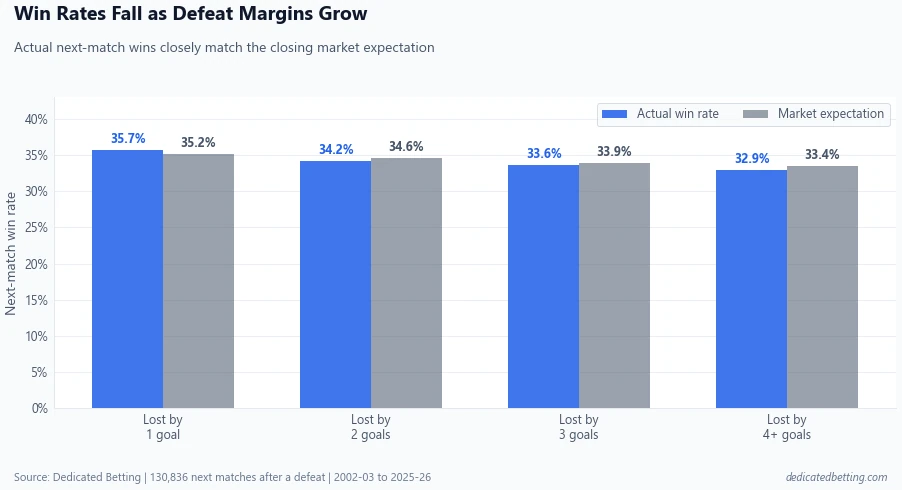
The chart shows why the bounce-back idea is less powerful than it first appears.
Teams coming off a one-goal defeat won 35.7% of their next matches. After a defeat by four or more goals, that fell to 32.9%. A heavier loss is therefore associated with a slightly lower chance of winning next time.
The market moved in almost perfect step. Its expectation fell from 35.2% after a one-goal defeat to 33.4% after a defeat by four or more.
Teams coming off a 3+ goal defeat won only 0.4 percentage points less often than the closing market expected.
In simple terms, the bookmakers didn’t overreact to the heavy defeat. They nudged the team’s rating down, but only by an amount that matched how the team actually played afterwards - meaning punters didn’t suddenly get easier value by backing them.
What Happened When You Backed Every Team?
The betting result is much clearer than the small difference between the actual and expected win rates.
A level-stakes bet on every qualifying team produced a loss of 2,163 units from 24,516 bets, equal to an ROI of -8.8%.
That means a bettor staking £10 every time would have risked £245,160 and lost approximately £21,630 across the full study. The cash example simply scales the level-stakes result. It does not account for changing stakes or betting limits.
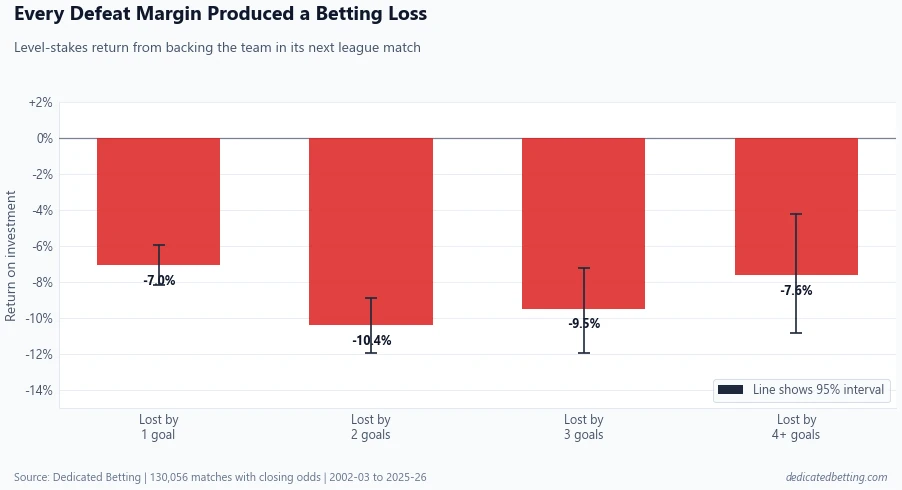
The size of the previous loss did not reveal a profitable threshold:
-
After losing by exactly three goals, the return was -9.5%.
-
After losing by four or more goals, the return was -7.6%.
The four-or-more group lost slightly less, but that is not evidence of a usable betting edge. Both results were clearly negative, and their uncertainty ranges overlap.
What this means for bettors: A heavy defeat may make the next match feel like a special situation. Across thousands of examples, it behaved much more like an ordinary priced football bet with the bookmaker margin still working against the bettor.
Does Returning Home Change the Picture?
One version of the bounce-back argument sounds especially persuasive: a team loses badly away, returns to its own stadium, and responds in front of its supporters.
The win rate certainly improved when the next match was at home. Teams that lost heavily away and then played at home won 39.3% of the time. Those staying away for the next match won only 24.5%.
That difference is real, but it is also obvious information. Home advantage is already built into the next-match price.
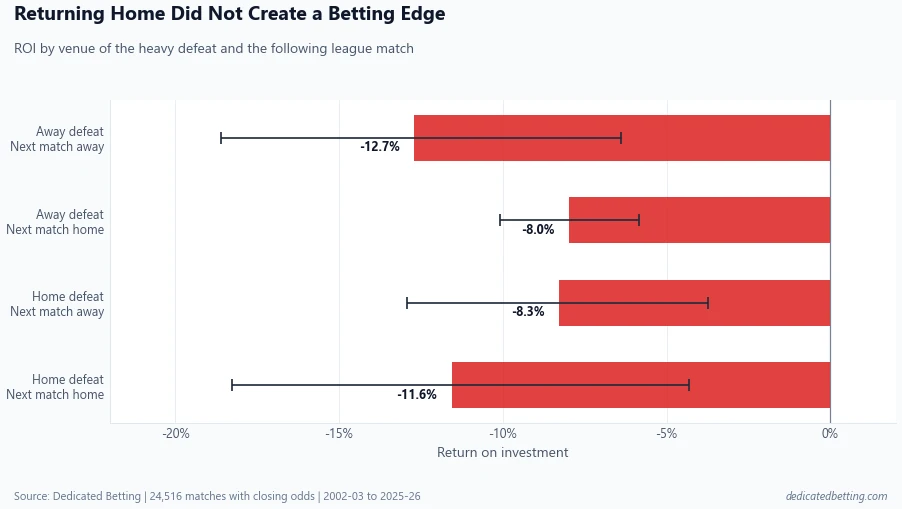
All four venue combinations lost money:
-
Heavy away defeat, next match away: -12.7%
-
Heavy away defeat, next match home: -8.0%
-
Heavy home defeat, next match away: -8.3%
-
Heavy home defeat, next match home: -11.6%
Returning home helped teams win more often. It did not help bettors beat the price.
This is an important distinction. A factor can be useful for predicting who is more likely to win without creating value. Home advantage changed the result probability, and the market changed the odds accordingly.
Was Any League Profitable?
No. The strategy produced a negative historical return in all 22 leagues.
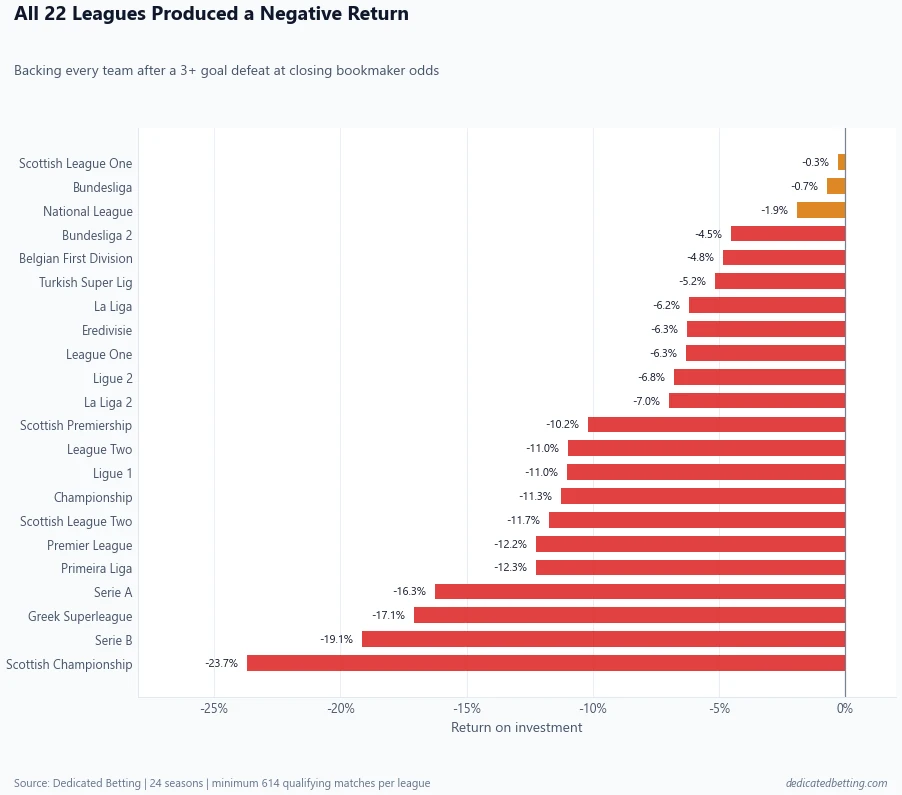
The closest results to break-even came in Scottish League One at -0.3% and the Bundesliga at -0.7%. At the other end, the Scottish Championship returned -23.7% and Serie B returned -19.2%.
Those differences are interesting descriptions of the historical sample, but they should not be treated as league-specific systems. Some competitions have smaller samples, and testing many leagues makes it easy to find unusually strong or weak results by chance.
The broader result is more useful: there was no competition in which blindly backing the bounce back produced a profit over the full period.
Did Stronger Teams Respond Better?
Yes, in the sense that stronger teams won more often. No, in the sense that backing them did not become profitable.
Teams in the strongest quarter of their division before the heavy defeat won 46.5% of their next matches. Teams in the weakest quarter won only 28.5%.
That should not be surprising. A good team remains more likely to win than a poor team, even after a bad result.
The market recognised the difference. The strongest group returned -7.4%, while the weakest group returned -5.7%. Every team-strength band produced a loss.
The practical lesson is simple: team quality still matters after a heavy defeat, but the defeat itself does not give you a shortcut around the odds.
Which Teams Had the Best Bounce-Back Records?
Team records add colour to the analysis, but they require extra caution.
Among teams with at least 50 qualifying cases across at least 10 seasons, Nice had the strongest historical record. They won 31 of 52 next matches, a 59.6% win rate compared with a market expectation of 36.1%.
Freiburg ranked second, winning 44 of 87, or 50.6%, compared with a market expectation of 33.4%.
At the other end, Dunfermline won 13 of 66 and Southampton won 14 of 73.
These numbers are interesting, but they are not reliable evidence that the same clubs will continue to behave that way. We tested 202 eligible teams, which creates many opportunities for extreme records to appear. None passed the stricter 5% test after allowing for all those comparisons. Only Nice and Freiburg passed the weaker 10% threshold.
There was also very little relationship between a team's record in the first half of the study and its record in the second half. Teams that ranked well earlier generally did not remain near the top later.
Team takeaway: Nice and Freiburg produced the most eye-catching historical records, but the rankings were not stable enough to use as a list of clubs to back after future heavy defeats.
What About a Red Card in the Heavy Defeat?
A red card offers a reasonable explanation for an unusually bad scoreline. If a team lost heavily only because it played much of the match with ten men, perhaps the result makes it look worse than it really is.
From 2017/18 onward, teams that received a red card in the heavy defeat won 33.7% of their next matches. Teams without a red card won 31.4%.
The red-card group returned -6.6% when backed, compared with -11.7% for teams whose heavy defeat contained no red card. That is an interesting difference, but the uncertainty around the red-card result was wide enough that the analysis does not establish a profitable exception.
A sending-off may therefore be useful match context. It is not sufficient evidence on its own to make the next bet good value.
Has the Pattern Changed Recently?
The result was not created only by older or less complete odds data.
For the seven completed seasons from 2019/20 to 2025/26, backing every team after a heavy defeat returned:
-
-11.2% using a closing bookmaker price from randomised bookmakers
-
-11.8% using the average closing price
-
-6.5% using the highest recorded closing price
Shopping around for the highest price reduced the loss substantially, which is a useful reminder that price matters and it can increase your profitability by using multiple bookmaker accounts. However, even with shopping around it still did not make this particular approach profitable.
Across the full 24-season study, only two seasons produced a positive return. The other 22 were negative.
Why the Bounce-Back Story Is So Appealing
The idea combines several powerful instincts:
-
A poor performance should produce greater effort next time.
-
A manager under pressure should demand a response.
-
A proud team should want to repair its reputation.
-
Other bettors may overreact to the latest scoreline.
Any of those things may be true in an individual match. The problem is moving from a believable story to a value bet.
The closing odds already reflect the team's quality, venue, opponent and recent results. Our data suggests that the market also handles the headline impact of a heavy defeat reasonably well. Across 24,688 cases, teams performed almost exactly as the price expected.
How Should Bettors Use a Heavy Defeat?
As our Football Betting Strategy: What the Data Actually Shows analysis found, simple strategies such as blindly backing favourites, home teams or underdogs do not produce consistent long-term profits. Backing every team after a heavy defeat is another appealing shortcut, but the results show that finding value requires more than following one historical pattern.
A heavy loss should therefore be treated as a reason to investigate the next match more closely, not as a betting signal by itself.
Ask what created the scoreline:
-
Was there an early red card?
-
Did the team concede from an unusually small number of shots?
-
Were important players missing or rested?
-
Was the opponent much stronger than the team they face next?
-
Does the result reflect a wider decline, or was it one abnormal performance?
-
Have the odds moved enough since opening to suggest that the market has changed its view?
This final question matters because the price determines whether a reasonable prediction becomes a worthwhile bet. A team may be capable of responding strongly and still offer poor value if its odds have already shortened to reflect that expectation.
Our head to head pages track odds movements for upcoming fixtures, alongside previous meetings, current form, home and away records, team comparisons and other betting context. This allows you to see whether the market is becoming more positive or negative about a team as kick-off approaches, rather than judging the opportunity from the previous result alone.
The historical evidence gives us an important starting point: the closing price did not leave a general bounce-back edge. The opportunity, if one exists in a particular match, must come from something more specific that the current odds may not fully reflect.
You can look for those edges using our league pages, which provide current tables, home and away splits, recent form and market-performance context along with how predictable each league is. Then, for a deeper team level analysis, our individual team pages help separate a single bad result from a longer pattern. This can help you to make better bets and become more profitable over the long run.
Final Verdict
Should you back a team simply because it has just suffered a heavy defeat?
No. Not as a standalone strategy.
Teams won roughly one in three next matches after losing by at least three goals, almost exactly as often as the closing market expected. Blindly backing them lost 8.8% of stakes, all 22 leagues produced a negative return, and only two of 24 seasons finished in profit.
That does not mean every team coming off a heavy defeat should be opposed. It means the expected reaction is already largely reflected in the odds.
Final thought: Do not bet on the promise of a reaction. Investigate why the heavy defeat happened, assess what has genuinely changed, and decide whether the available price is wrong.
Data from the Dedicated Betting database: 24,688 team-match observations across 22 European leagues and 24 completed seasons from 2002/03 to 2025/26. A heavy defeat is defined as losing the previous league match by three or more goals. Follow-up matches crossing a season boundary were excluded. Betting returns use level stakes at closing bookmaker odds. Historical results do not predict future returns.
Related football articles
Does recent form predict football results?
Our Last 5 Form analysis explains why recent form predicts results but does not automatically create a betting edge.
Does the market overreact to winning and losing streaks?
See how consecutive results affect prices and returns in Does Form Matter in Football Betting.
What does value betting actually mean?
Our Value Betting guide explains why finding likely winners and finding mispriced odds are two different tasks.