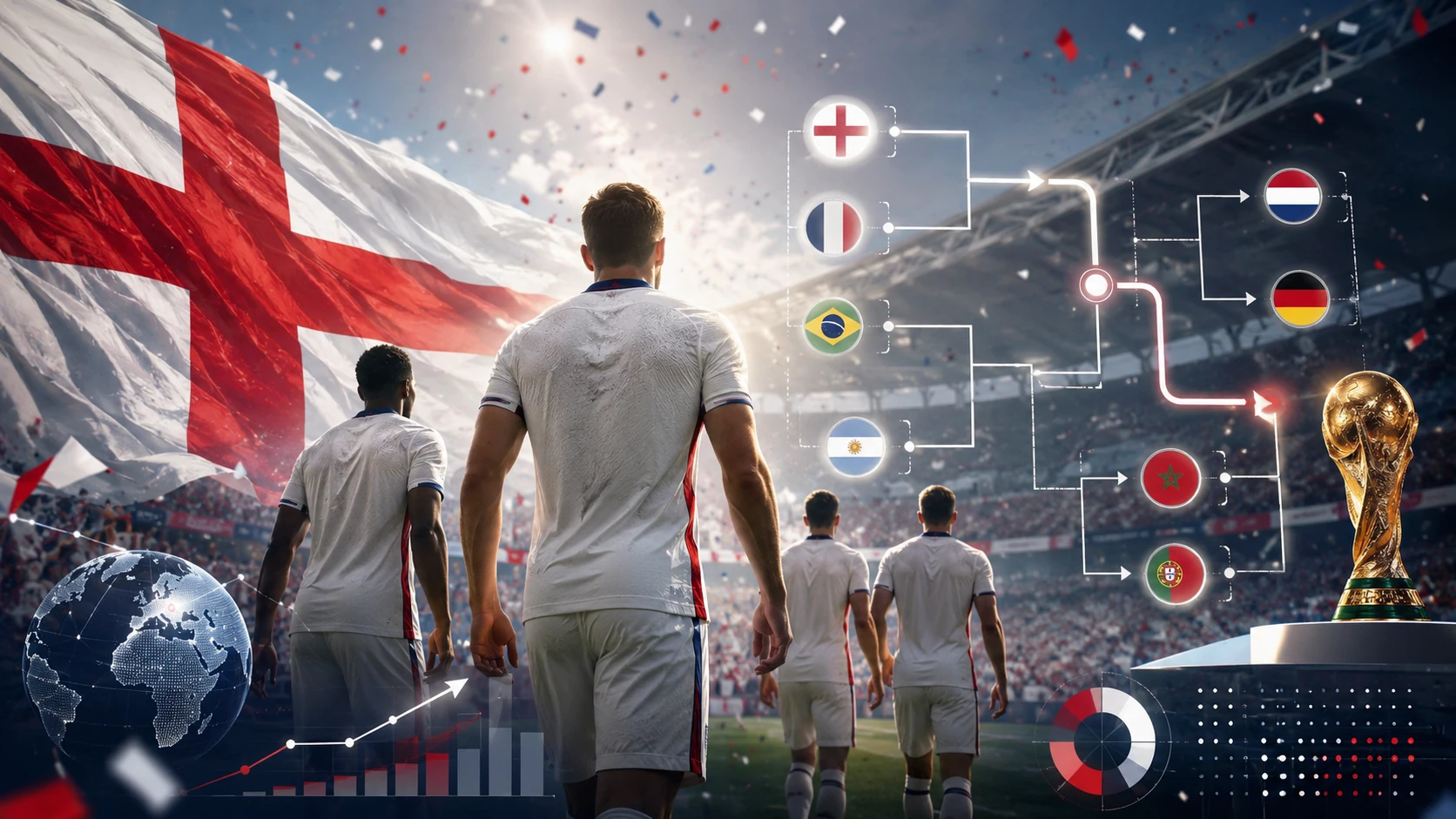
England arrive at the 2026 World Cup as one of the genuine contenders with the hopes of a Nation keen for more World Cup success. They come into the World Cup perhaps not as clear favourites, but as a team with the depth, the structure and the tournament pedigree to go deep in North America. Thomas Tuchel oversaw a historic qualifying campaign, Harry Kane, at 32, is currently the most prolific striker in Europe, and Group L represents as kind a draw as England could have hoped for.
Our predictive model gives England a 27.4% chance of reaching the semi-finals, placing them among the top four or five teams in the field. Whether they fulfil that probability depends on Kane's fitness, how Tuchel navigates the heat and a QF bracket that could pit them against France, Brazil or the Netherlands. This is the full picture.
For live group standings, fixtures and match analysis throughout the tournament, visit England's World Cup 2026 team page.
The Group: Group L
England are in Group L alongside Croatia, Ghana and Panama. On paper it is one of the more manageable draws available.
| Team | Avg Age | Model SF% |
|---|---|---|
| England | 26.2 | 27.4% |
| Croatia | 27.3 | 13.4% |
| Ghana | 26.2 | - |
| Panama | 29.4 | 1.5% |
Panama arrive with the oldest squad in the entire tournament at 29.4 average age (joint-highest with Iran). They are a veteran side that has qualified ahead of more fancied CONCACAF rivals but whose ceiling is limited. Croatia bring tournament experience through Luka Modric (one of the tournament elders at 40) but Zlatko Dalić's side is further into a transition than their reputation suggests. Ghana are rebuilding under Carlos Queiroz, two months into the role, and their chances are estimated to be very limited.
England became the first European side in history to win all eight World Cup qualifiers without conceding a single goal. They scored 22 times in the process, with Kane accounting for eight of them. The model places England as clear group favourites with a 54.4% chance of topping Group L.
The Squad
England's 26-man squad is described as the most experienced the country has ever sent to a World Cup. 22 of the 26 have won a trophy since the start of the 2024–25 season, and the group carries a combined 71 World Cup appearances between them. The average age is 26.2.
The selection raised eyebrows. Cole Palmer, Phil Foden and Adam Wharton were all absent, and the absence of a reliable defence-splitting passer is a legitimate tactical concern. Tuchel's response is that he selected players for defined roles, not reputations and it continues to reflect his broader philosophy when it comes to managing England at this World Cup. His "special operations team" on the bench has been specifically assembled to change games in the final third of matches, something which could become more relied upon as the tournament progresses.
The key players are clear.

 >
Bayern Munich · Striker
>
Bayern Munich · Striker
Kane's 61 club goals this season, 19 more than any other player in Europe's top five leagues, represent the most prolific campaign of his career and match Cristiano Ronaldo's best-ever club season. His international scoring rate of 0.70 goals per cap is elite. England's win rate with him in the team since 2022 is 75%; without him it is 29%. The central dependency is both the squad's greatest asset and its clearest vulnerability. See our World Cup 2026 Golden Boot analysis for the full assessment of his odds.
John Stones has started England's last 26 major tournament games despite managing only 12.8% of possible Premier League minutes this season in his Manchester City swansong. His 95% passing accuracy is the highest of any World Cup player since records were kept from 1966. His fitness heading into the tournament is a genuine concern and questions remain on how many minutes he can deliver over a condensed tournament format.
Elliot Anderson had the most touches (3,300), won the most duels (297) and won the most possession (306) of any top-flight player this season. His emergence has resolved a long-standing problem in the holding midfield role and the 23 year-old will be looking to carry his form into his first major International tournament.
Thomas Tuchel
Tuchel became England's first German manager and only their third foreign head coach in January 2025, following Sven-Göran Eriksson and Fabio Capello. His 18-month contract was extended to Euro 2028 in February 2026 after an excellent start. His managerial record with England stands at 10 wins, one draw and two losses from 13 games, a 76.9% win rate.
His CV is remarkable: DFB-Pokal with Borussia Dortmund, two Ligue 1 titles and a Champions League final appearance with PSG, then the Champions League itself with Chelsea in 2021, where he was named FIFA's Best Coach, and the Bundesliga with Bayern Munich.
He is known as a tactical chameleon: versatile in formation, demanding in training, and relentless in preparation. He reportedly paused a Pep Guardiola documentary for two hours on the Mainz team bus to study a graph of Barcelona's passing patterns. That rigour defines his approach.
His desire with England is direct and physical, reflecting Premier League principles, but the sapping North American heat will require careful management of intensity and squad rotation. The March friendlies (a 1–1 draw with Uruguay, a 1–0 defeat to Japan) were a reminder that England without Kane in full flow look significantly diminished, other players will have to step up for England to truely have a chance.
England's World Cup History
England are one of only eight nations to have won the World Cup, they have done it once, in 1966 on home soil, and the wait since is the defining tension of English football.
The highlights:
- 1966 - Champions. Geoff Hurst's hat-trick in the final against West Germany (4–2 AET) remains the only World Cup final hat-trick until Mbappé's in 2022. Bobby Charlton won the Golden Ball. England did not concede in their first four matches.
- 1990 - Fourth place in Italy. Paul Gascoigne's tears became one of the tournament's defining images. Gary Lineker scored four goals in the tournament, adding to his six from 1986, his 10 World Cup goals remain the England record.
- 2018 - Fourth place in Russia. Their first World Cup semi-final in 28 years, beaten by Croatia in extra time. Kane won the Golden Boot with six goals.
- 2022 - Quarter-final in Qatar. Beaten 2–1 by France in a match where Kane had a penalty saved in the final minutes when England trailed 2–1.
England's top World Cup goalscorers:
| Player | Goals | Tournaments |
|---|---|---|
| Gary Lineker | 10 | 1986, 1990 |
| Harry Kane | 8 | 2018, 2022 |
| Geoff Hurst | 5 | 1966, 1970 |
| Bobby Charlton | 4 | 1962, 1966 |
| Michael Owen | 4 | 1998, 2002 |
England have qualified for 19 of 22 World Cups, missing out only in 1974, 1978 and 1994. They have failed to advance from the group stage three times: in 1950, 1958 and 2014. Their most recent QF exit in 2022 was their joint-deepest run in 32 years.
What the Prediction Model Says
Our tournament prediction model rates England as one of the four or five most likely champions, with a 7.8% probability of winning the tournament. Compared to the rest of the field, that places them below Spain (21.2%), Argentina (15.4%) and France (18.0%), and just above the likes of Germany (4.7%) and Brazil (2.6%).
| Stage | Probability |
|---|---|
| Win Group L | 54.4% |
| Reach Round of 32 | 94.4% |
| Reach Round of 16 | 72.6% |
| Reach Quarter-final | 44.6% |
| Reach Semi-final | 27.4% |
| Reach Final | 15.6% |
| Win Tournament | 7.8% |
Probability of advancing from Group L - England are clear favourites in a group containing Croatia, Ghana and Panama.
Probability of reaching the Round of 16. England's R32 draw as group winners is favourable - a third-place team from a pool that includes manageable opposition.
Probability of reaching the quarter-finals - reflecting a bracket that could include France, Brazil or the Netherlands at that stage.
Probability of reaching the semi-finals, placing England in the top four or five nations in the model.
Probability of reaching the final - placing England among the four most likely finalists alongside Spain, France and Argentina.
Probability of winning the tournament - behind Spain (21.2%), France (18.0%) and Argentina (15.4%) but a meaningful chance for a nation that has not lifted the trophy since 1966.
The Route to the Final
England's bracket path depends significantly on whether they top Group L or finish second. The difference is substantial, although ultimately any team who wins the tournament will likely need to beat a couple of the worlds top nations.
Path A: England win Group L (54.4% probability)
Round of 32 Opponents: The third-place finisher from Groups E, H, I, J or K assigned to this slot. The pool includes teams such as Norway (58.2% to advance from group), Uruguay (69.6%) and Austria, none of whom represent elite opposition. England would be strong favourites here regardless of the specific draw.
Round of 16 Opponents: The winner of Group A - Mexico, South Korea, Czech Republic or South Africa. South Korea (46.7% to reach the R16) and Mexico are the likeliest Group A winners. This remains a favourable match for England at this stage.
Quarter-final Opponents: The winner from the France/Brazil/Netherlands/Scotland/Morocco bracket. This is where England's path becomes genuinely difficult. France (81.4% to reach the R16, 42.6% to reach the SF) are the most likely team from this bracket. Brazil (54.5% R16) and the Netherlands (48.5% R16) are also strong candidates. A QF against any of these three would be a significant test and is the most probable point at which England's tournament run would be decided.
Semi-final Opponents: The winner from the Spain/Argentina/Portugal/Uruguay bracket. Spain (our model's overall favourites at 21.2% to win the tournament) or Argentina (15.4%) are the likeliest semi-final opponents for England if they reach that stage. Portugal (10.1% to reach the final) could also emerge.
Path B: England finish second in Group L (~46% probability)
Round of 32 Opponents: Group K runners-up, most likely Portugal (21.0% SF probability) or Colombia (6.3%), depending on which team tops Group K. Portugal are Group K favourites at 59.2% to win the group, making Colombia the likely runners-up. Either opponent is beatable but neither is a lightweight, this is a harder R32 than Path A offers.
Round of 16 Opponents: Winner of Group H winners versus Group J runners-up. Spain are 74.1% likely to top Group H. Argentina are 67.3% likely to win Group J, leaving Austria or Algeria as their probable runners-up. The most likely R16 outcome is England facing Spain, our model's outright tournament favourites at 21.2%, just four matches in. This is the single most significant difference between the two paths and highlights the likely importance of winning Group L.
Quarter-final Opponents: Winner from the Belgium/USA bracket, Group G winners versus Group D winners. Belgium (50.1% to win Group G, 30.7% to reach the QF) are the likeliest team from this side of the draw. After navigating Spain in the Round of 16, England would face a considerably more manageable QF opponent than in Path A.
Semi-final Opponents: Winner from the France/Brazil/Germany/Netherlands bracket. France (42.6% SF probability), Germany (22.7%) and Brazil (16.0%) are all credible semi-final opponents from this side of the draw. England would meet one of them here regardless of which path they took through the earlier rounds.
Finishing second in the group means absorbing the toughest potential opponent, Spain or Argentina, in the Round of 16 rather than the semi-finals. The difficulty does not disappear; it just shifts forward. Both paths lead to roughly the same semi-final landscape, but Path B compresses the hardest fixtures into earlier rounds with less recovery time between them.
Verdict
England have the squad depth, the manager and the bracket conditions to reach the semi-finals or beyond. The path as group winners is genuinely navigable through the Round of 16 and requires beating one of the tournament's elite sides at the QF stage, which is exactly where the model's 44.6% probability places them.
The central dependencies are well-known. Kane's fitness and form is the most critical, the gap between England with and without him is stark. Stones's availability remains uncertain after a season largely spent on the treatment table. And several key players, including Declan Rice and Bukayo Saka, arrive carrying the accumulated load of 50-plus games for club and country. Whether Tuchel can manage those minutes carefully enough to keep his squad sharp, and whether the physical intensity he demands can be sustained in the North American summer heat, are questions the March friendlies raised without yet answering.
The model's 7.8% win probability is neither dismissive nor inflated. It places England where the evidence suggests they belong - a serious contender without being the clear favourite, in a tournament where Spain, France and Argentina start ahead of them.
Three key numbers: 94.4% - the probability England advance from the group. 44.6% - the probability they reach the quarter-finals. 7.8% - the probability they go all the way.
For live predictions and match-by-match analysis throughout the tournament, see England's World Cup 2026 team page and our World Cup 2026 predictions section.
Tournament probabilities from our World Cup 2026 model, based on FIFA ranking data and international results history. Squad statistics from the 2025–26 season. Bracket path analysis based on the confirmed 2026 World Cup knockout structure.
Related articles
World Cup 2026 Golden Boot Odds
Harry Kane at 13/2 - our full analysis of the top goalscorer market using team progression probabilities, club form and penalty duties: World Cup 2026 Golden Boot Odds.
World Cup 2026 Group Predictions
Every group broken down by qualification probability and the teams the market has mispriced: World Cup 2026 Group Predictions.
World Cup 2026 Predictions
Our model rates all 48 teams and simulates the full bracket. Spain lead at 21.2%, but the most interesting outputs are where the model and the market diverge: World Cup 2026 Predictions.