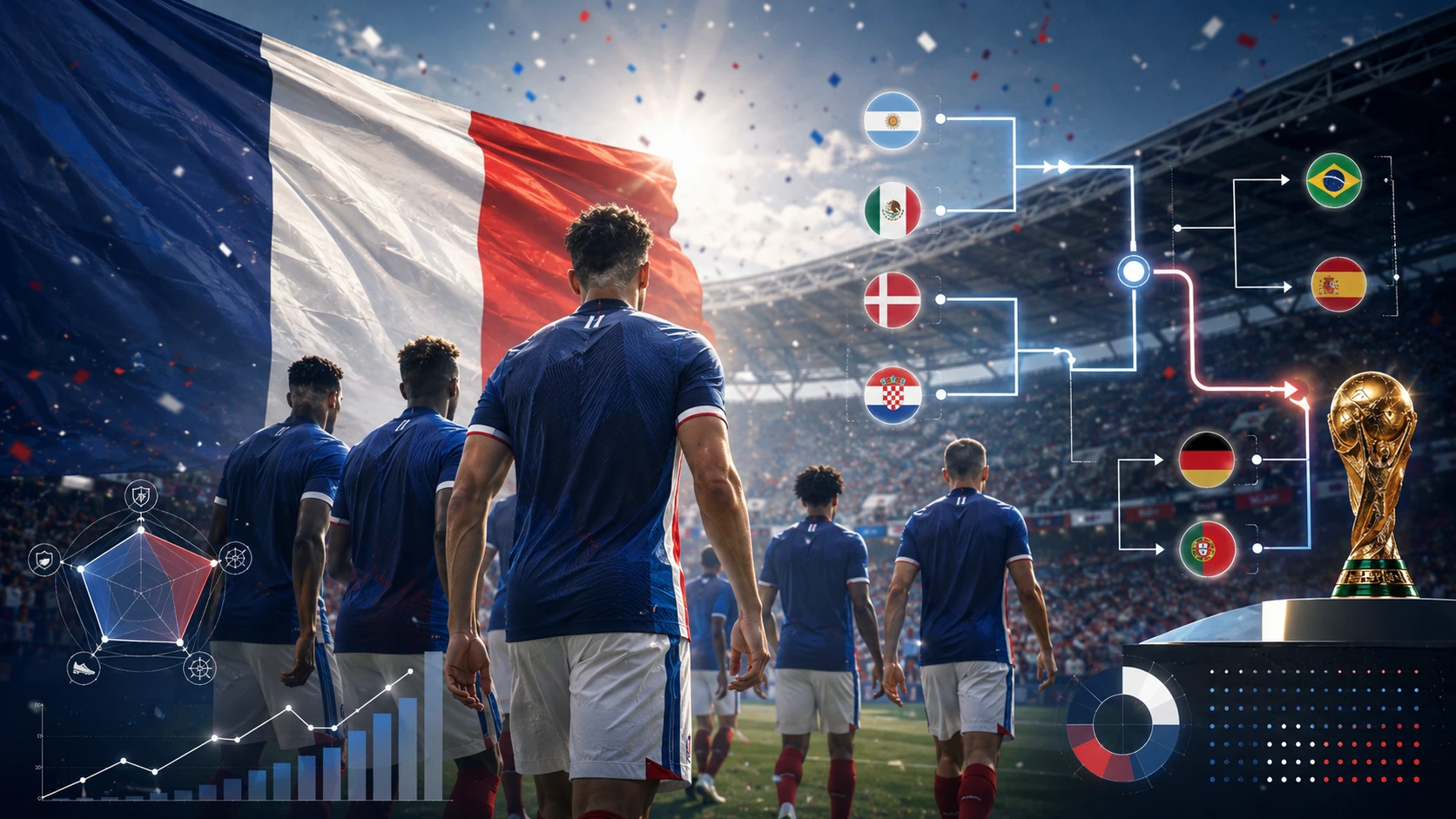
Fourteen years. Five major tournament finals. One final chance. Didier Deschamps steps down as France manager after this tournament and the script he is chasing is almost too neat: a third World Cup title as player and coach. Only Mario Zagallo and Franz Beckenbauer have done it before him, and Deschamps is now the only living man who can say he has won the tournament in both roles. This is his last opportunity to complete the set.
The model places France as the second most likely champions at 18.0%, behind Spain but ahead of Argentina and England. Their squad is described by some observers as the most balanced and talented in the tournament, with nine attacking players carrying a combined market value of more than €800m. The question that has haunted Deschamps throughout his reign, whether he will ever fully unleash it, arrives at its final reckoning.
For live group standings, fixtures and match analysis throughout the tournament, visit France's World Cup 2026 team page.
The Group: Group I
France are in Group I alongside Senegal, Norway and Iraq. The group is navigable but carries one significant historical footnote.
| Team | Avg Age | Model SF% |
|---|---|---|
| France | 26.0 | 42.6% |
| Norway | 25.9 | 2.5% |
| Senegal | 26.1 | - |
| Iraq | 26.2 | - |
France's group-stage schedule runs: Senegal (16 June, New York/New Jersey), Iraq (22 June, Philadelphia), Norway (26 June, Boston).
The Senegal opener carries a specific weight. France have played Senegal once in competitive football, and lost. That was the 2002 World Cup group stage, when an unfancied Senegalese side delivered one of the tournament's great upsets against the reigning world champions. France were eliminated in the group stage without scoring a goal. The 2026 opener is a genuine test, not a formality.
Norway are managed by Ståle Solbakken and carry Erling Haaland, the most prolific striker in our dataset, but the model rates Norway's semi-final probability at just 2.5%. The group as a whole gives France a 64% chance of topping it. Iraq have never played France in competitive football.
The Squad
France arrive with what Lucas Hernandez described as "the best attack in the world", and the market valuations lend credence to that claim. Mbappé, Dembélé, Olise and Désir Doué alone are estimated at €530m, more than the combined market value of Brazil's entire World Cup attack.
The tactical shift under Deschamps this cycle has been significant. A new 4-2-3-1 formation places Michael Olise as a number 10, with Dembélé operating from the right with the freedom to build attacks between the lines. After the curiously listless Euro 2024 in which France scored just three times from open play, lessons have apparently been learned.
The March friendlies against Brazil and Colombia in the United States were encouraging, five goals in two games, a level of attacking enterprise that had been absent. Deschamps said he wanted the team to be "less predictable and readable." Whether the handbrake stays off in a tournament setting is the defining question of his final reign.
The concern remains the left-back position, exposed by a surprise friendly loss to Ivory Coast on 4 June. Lucas Hernandez, Theo Hernandez and Lucas Digne are all options, each with their own balance of attacking quality and defensive reliability. It remains unresolved.
The average squad age is 26.0, the youngest of any team in Group I. N'Golo Kanté (34) is the oldest player in the squad; Warren Zaïre-Emery (19) the youngest.

 France · Striker
Mbappé scored 42 goals in 44 games for Real Madrid in 2025–26 and arrives as the highest World Cup scorer of the modern era with 12 goals across the last two tournaments, including a hat-trick in the 2022 final. He needs four more to equal Miroslav Klose's all-time World Cup record of 16, a milestone that is within reach across six or seven matches. As both captain and the designated penalty taker, France's tournament runs through him entirely. See our Golden Boot analysis for the full assessment of his odds at 11/2.
Ousmane Dembélé made just 11 starts in 22 Ligue 1 games for PSG yet still won the league's player-of-the-year award, averaging 1.4 goals and assists per 90 minutes, bettered only by Harry Kane (1.6) across Europe's top five leagues. He also scored in the Champions League final win against Arsenal.
Michael Olise provided 26 assists across all competitions for Bayern Munich, at least four more than any other player in Europe's elite leagues. Operating as Deschamps' number 10, he connects France's defensive structure to its attacking riches.
Warren Zaïre-Emery (19) scored on his France debut at 17 and, after a difficult period, has re-established himself as a key member of PSG's midfield. Deschamps has identified him as a potential solution to the right-back problem as well as a central midfield presence.
Didier Deschamps
Deschamps is 57 years old and has been France's manager since 8 July 2012 - 14 years, making him by far the longest-serving head coach at this tournament. His managerial record with France stands at 115 wins, 35 draws and 29 losses from 179 games, a win rate of 64.25%.
His playing career was decorated: two Division 1 titles and the UEFA Champions League with Marseille, three Serie A titles and another Champions League with Juventus, the FA Cup with Chelsea. He captained France to the 1998 World Cup title and Euro 2000, making him one of only three men to win the World Cup as both player and coach. Zagallo and Beckenbauer, the others, are gone. Deschamps stands alone.
As a manager, his reputation for pragmatism has been both his shield and his millstone. Antoine Griezmann's summary of France under Deschamps, "it is a pain to watch, but it makes you win", became famous during Euro 2024. His response to critics has consistently been to point at the trophy cabinet. Back-to-back World Cup finals (2018 win, 2022 runners-up), a Euros final in 2016, a Nations League title in 2021. The results justify the approach.
His contract ends in July 2026. Zinedine Zidane, France's 1998 World Cup-winning playmaker and the player who perhaps best embodied the opposite of Deschamps' cautious style, is widely expected to succeed him.
France's World Cup History
France have appeared in 17 World Cups, winning twice and reaching the final four times in the past seven editions, at least twice as often as any other nation in that period.
The highlights:
- 1958 - Third place in Sweden. Just Fontaine scored 13 goals, a record that stands to this day, six decades later.
- 1998 - Champions on home soil. Zinedine Zidane's two headers in the final, a 3–0 defeat of Brazil, gave France their first World Cup. Deschamps lifted the trophy as captain.
- 2006 - Runners-up in Germany. Zidane's headbutt in the final, a penalty shootout defeat to Italy, denied France a second title.
- 2018 - Champions in Russia. Mbappé became the second teenager after Pelé to score in a World Cup final. Deschamps lifted the trophy again, this time as coach.
- 2022 - Runners-up in Qatar. Mbappé scored a hat-trick in the final, only the second hat-trick in a World Cup final after Geoff Hurst's in 1966, but Argentina won 4–2 on penalties.
France are attempting to become only the third nation to reach three consecutive World Cup finals, after West Germany (1982, 1986, 1990) and Brazil (1994, 1998, 2002). They are also the only European nation to have won every senior FIFA and UEFA competition.
France's World Cup record:
| Tournament | Result |
|---|---|
| 1998 | Champions |
| 2002 | Group stage exit |
| 2006 | Runners-up |
| 2010 | Group stage exit |
| 2014 | Quarter-final |
| 2018 | Champions |
| 2022 | Runners-up |
What the Model Says
Our model rates France as the second most likely champions, 3.2 percentage points behind Spain. Their semi-final probability (42.6%) is the second highest in the field and their path through the bracket as group winners is one of the cleaner draws available.
| Stage | Probability |
|---|---|
| Win Group I | 64.0% |
| Reach Round of 32 | 96.4% |
| Reach Round of 16 | 81.4% |
| Reach Quarter-final | 59.7% |
| Reach Semi-final | 42.6% |
| Reach Final | 27.6% |
| Win Tournament | 18.0% |
Probability of advancing from Group I - France are clear favourites in a group containing Senegal, Norway and Iraq.
Probability of reaching the Round of 16 - the second highest of any team in the tournament.
Probability of reaching the quarter-finals - meaning France are more likely than not to be in the last eight.
Probability of reaching the semi-finals, placing France second in the model behind Spain (45.8%).
Probability of reaching the final - the second highest in the field and almost double England's equivalent figure.
Probability of winning the tournament - behind Spain (21.2%) but ahead of Argentina (15.4%) and England (7.8%).
The Route to the Final
France's bracket path is one of the cleaner draws in the tournament for a top-seeded nation - provided they win Group I.
Path A: France win Group I (64% probability)
Round of 32 Opponents: The third-place finisher from Groups C, D, F, G or H assigned to this slot. The pool potentially includes teams such as Morocco, USA, Uruguay or Belgium, all beatable for a team of France's calibre. France would be strong favourites regardless of the specific draw.
Round of 16 Opponents: Winner of Group F versus Group C runners-up. Group F contains the Netherlands (48.5% to reach the R16) and Japan, while Group C's runners-up, after Brazil are likely to top it, would most likely be Morocco or Scotland. The most probable R16 opponent for France is the Netherlands, who are a genuine test but firmly in the bracket of teams France should expect to beat at this stage.
Quarter-final Opponents: Winner from the England/Mexico bracket. This is the most intriguing fixture France could face at the QF. England's bracket places them on a collision course with France in the last eight, the model's 44.6% QF probability for England and 59.7% for France confirm both nations' credible routes to this point. A France vs England quarter-final would be a genuinely significant occasion; France's all-time record against England stands at 11 wins, 6 draws and 17 losses.
Semi-final Opponents: Winner from the Argentina/Colombia bracket. The semi-final opponent most likely emerging from this half of the draw is Argentina (42.1% SF probability), the reigning world champions and France's 2022 final opponents. A rematch of that final at the semi-final stage would be a fitting context for the latter stages of Deschamps' reign.
Final Opponents: Winner from SF Match 101 - the Spain/Germany/Brazil side of the draw. As group winners, France would not meet Spain or Germany until the final itself, if both progress that far.
Path B: France finish second in Group I (~36% probability)
Round of 32 Opponents: Group E runners-up - most likely Ivory Coast or Ecuador, given Germany are 66.3% likely to win Group E. This is a manageable R32 regardless.
Round of 16 Opponents: Winner of Group C winners versus Group F runners-up. This is the significant difference from Path A. Group C winners are most likely Brazil (who France avoided in Path A's bracket). A France vs Brazil Round of 16 is a sharply harder assignment than Netherlands/Japan.
Quarter-final Opponents: Winner from the Germany bracket, Group E winners (Germany, 66.3% to win the group) are the most likely QF opponent after navigating Brazil in the R16.
Semi-final Opponents: Winner from the Spain/Colombia bracket - Spain (45.8% SF probability) are the most likely semi-final opponent from this side of the draw.
As runners-up, France would face Brazil, Germany and Spain in sequence, three of the tournament's elite teams across three consecutive knockout rounds. The difference in path difficulty between winning and finishing second in Group I is as stark for France as for almost any other nation in the field.
Verdict
France are the second most likely winners of this tournament and the data supports that position at every stage of the bracket. The attacking talent at Deschamps' disposal is extraordinary; the question of whether he will deploy it fully enough to overcome Spain in a final, or Argentina in a semi, remains open.
The central dependencies are clear. Mbappé's form and fitness are foundational, France's attack is built around him. The left-back position remains unresolved after the Ivory Coast friendly and represents a genuine vulnerability against side that attack with width. And Deschamps' willingness to trust the expansive 4-2-3-1 that worked so well in the March friendlies, rather than reverting to the conservative template that characterised Euro 2024, will determine whether this squad reaches its ceiling.
Winning Group I is particularly valuable here. Path A keeps Argentina and Spain out of the bracket until the semi-final at the earliest and puts the Netherlands and England as the two most likely knockout opponents before that stage, difficult, but not insurmountable. The final chapter of Deschamps' career deserves the best possible conditions to play out in.
Three key numbers: 96.4% - the probability France advance from the group. 59.7% - the probability they reach the quarter-finals. 18.0% - the probability they win it all.
For live predictions and match-by-match analysis throughout the tournament, see France's World Cup 2026 team page and our World Cup 2026 predictions section.
Tournament probabilities from our World Cup 2026 model, based on FIFA ranking data and international results history. Squad statistics from the 2025–26 season. Bracket path analysis based on the confirmed 2026 World Cup knockout structure.
Related articles
World Cup 2026 Golden Boot Odds
Kylian Mbappé at 11/2 - our full analysis of the top goalscorer market, including why France's semi-final probability makes him a genuinely defensible favourite: World Cup 2026 Golden Boot Odds.
England at the World Cup 2026
England's full guide - Tuchel's squad, model predictions and the route to the final that could pit them against France in the quarter-finals: England at the World Cup 2026.
World Cup 2026 Predictions
Our model rates all 48 teams and simulates the full bracket. Spain lead at 21.2%, but France are 0.2 percentage points behind them on final probability: World Cup 2026 Predictions.