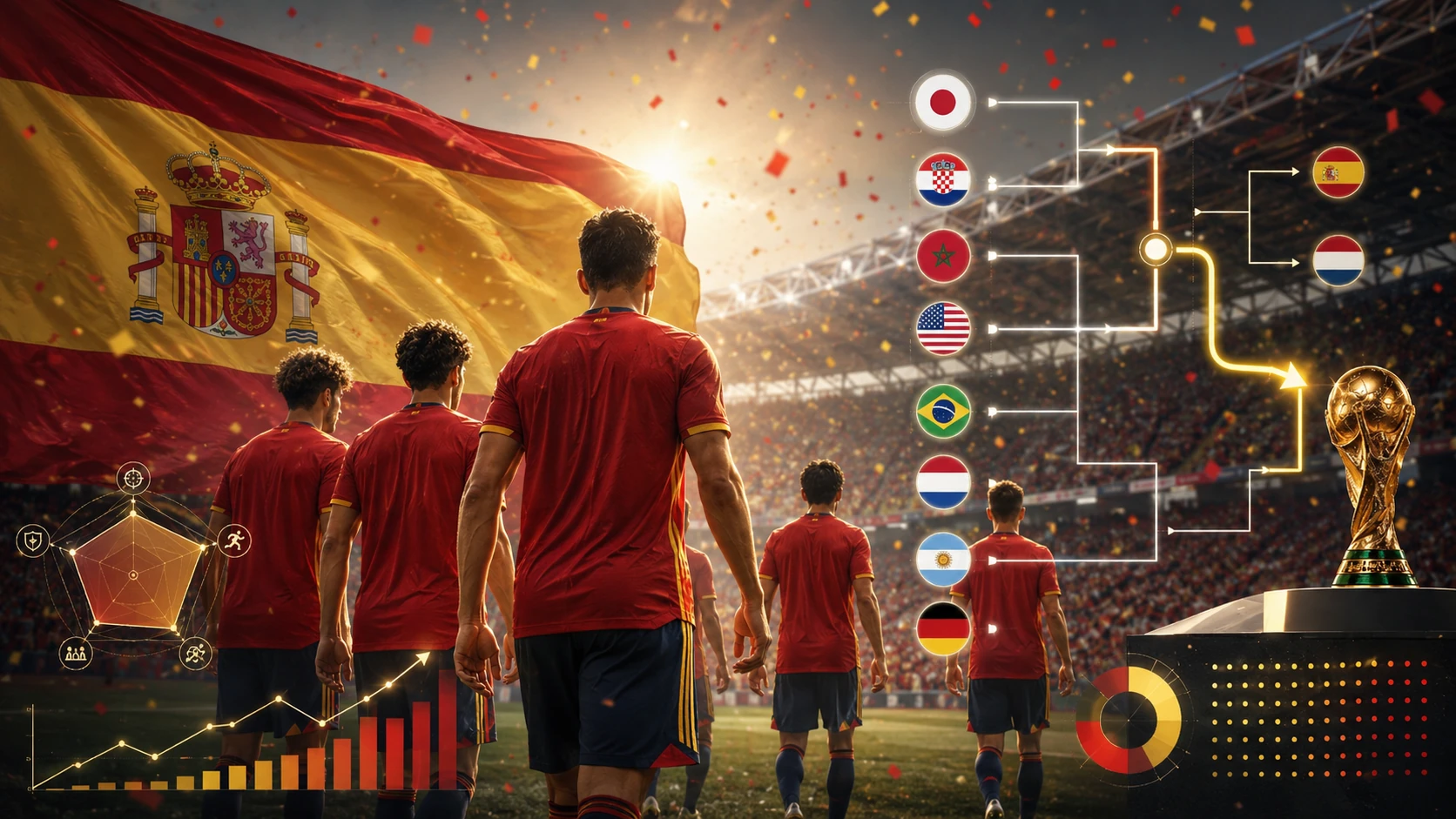
Spain arrive at the 2026 World Cup as the model's outright favourites, the reigning European champions and on an unbeaten run stretching back to March 2023. Thirty-three games without defeat. Seven wins from seven at Euro 2024, setting records for most goals and most different scorers at a single European Championship. A squad that De la Fuente has built through conviction in youth and the continuity of his youth academy pipeline rather than galácticos and reputation.
Our data model gives Spain a 21.2% chance of winning the tournament, the highest of any team in the field. History, however, offers a specific caution: since 1990, European Championship winners have progressed beyond the first round of the subsequent World Cup just twice. Both exceptions are West Germany (1972/1974) and Spain themselves (2008/2010). They are attempting to become the second team to repeat that feat, and the first in over fifty years.
For live group standings, fixtures and match analysis throughout the tournament, visit Spain's World Cup 2026 team page.
The Group: Group H
Spain are in Group H with Cape Verde, Saudi Arabia and Uruguay, one of the more favourable draws available to a top seed.
| Team | Avg Age | Model SF% |
|---|---|---|
| Spain | 25.7 | 45.8% |
| Uruguay | 27.8 | 3.9% |
| Saudi Arabia | 27.6 | - |
| Cape Verde | 28.7 | - |
The fixtures run: Cape Verde (15 June, Atlanta), Saudi Arabia (21 June, Atlanta), Uruguay (27 June, Guadalajara). The Uruguay game in Mexico is the most interesting, Spain and Uruguay have met twice at World Cups before, both ending in draws (1966 and 1990). Uruguay carry a collective experience and a Bielsa-shaped structure that will not simply capitulate.
Spain swaggered through qualifying, scoring 19 unanswered goals in their first five games before dropping points late, a 2–2 draw with Turkey, their only blemish. They conceded just two goals across the entire campaign. The model places them as Group H favourites at 74.1% to top it. Saudi Arabia (managed by Giorgios Donis, in charge for just one month) and Cape Verde represent the group's modest ceiling.
The Squad
Spain's 26-man squad carries one historically notable detail: for the first time ever at a World Cup, not a single Real Madrid player has been selected. De la Fuente's philosophy, "I don't consider where players come from, only whether they are useful", has produced a squad drawn from 10 different clubs, a stark contrast to the 2010 era when almost all starters played for Real or Barcelona.
The average squad age is 25.7, the fourth youngest in the tournament and the youngest of any realistic contender. The oldest player is Borja Iglesias (32); the youngest, Pau Cubarsí (18), a Barcelona centre-back who may be a fraction short of experience for the biggest stage but whose talent is unquestioned. Spain's attacking depth is extensive: nine forwards and attacking midfielders in a squad that also contains the depth of Rodri in midfield and one of the best goalkeeper options in Unai Simón or David Raya.
The significant uncertainty surrounds the two players who made Spain's Euro 2024 run so electric.

 Spain · Right Winger
Yamal was the 2025 Ballon d'Or runner-up and had contributed 24 goals and 17 assists in 45 games for Barcelona before a hamstring injury in April disrupted his preparation. He became the first 16-year-old to play and score at the Euros and turns 19 five days before the World Cup final on 19 July. His fitness is the single most important variable in Spain's tournament prospects. with him at full capacity, Spain's attack operates at a different level than without him. See our Golden Boot analysis for the assessment of his odds at 18/1.
Nico Williams (Athletic Bilbao) shares the left side with Yamal's right and has been equally important to Spain's directness and pace in transition. He arrived at the World Cup carrying a persistent groin issue, a concern throughout the season before a hamstring problem in May. De la Fuente has suggested there is little reason to risk either player in the opener against Cape Verde.
Mikel Oyarzabal (Real Sociedad) is the central striker and designated penalty taker. He came off the bench to score the Euro 2024 final winner against England and has since established himself as a starter. His role is less spectacular than Yamal's but structurally more important for the Golden Boot market, he is Spain's primary finisher and the player most likely to accumulate goals across a full tournament run.
Fabián Ruiz (PSG) is one of the tournament's most underrated midfielders. At Euro 2024, he won possession in the final third 14 times across the tournament, twice as often as any other player in the field.
Rodri (Manchester City) provides the defensive anchor and, when Spain control a match, the tempo-setter. His composure under pressure is the foundation on which Spain's attacking freedom is built.
Luis de la Fuente
De la Fuente is 64 years old and has been part of the Spanish football setup since 2013, progressing through U19 and U21 roles before taking charge of the seniors in December 2022 after Luis Enrique's exit following the 2022 World Cup round-of-16 elimination by Morocco.
His record with the seniors stands at 31 wins, 9 draws and 2 losses from 42 games, a 73.81% win rate. He has won every competition he has entered with Spain: the Nations League (2022–23), Euro 2024, and was named the world's best national coach in both 2024 and 2025.
His background is almost entirely in the Spanish youth system, and it shows in his approach. Players he developed at U19 and U21 level, such as Merino, Olmo, Oyarzabal, Fabián Ruiz and Unai Simón, are now the backbone of the senior squad. He has described his philosophy as "not a pose, it is a conviction": commit to the players from the grassroots, maintain the environment, and the results follow.
His contract runs until Euro 2028. Unlike Deschamps, this is not De la Fuente's farewell tour, it is a continuation.
Spain's World Cup History
Spain have appeared in 16 World Cups and won it once, in 2010. Before that triumph, their best result was a fourth-place finish in 1950. The 2010 campaign was surgically efficient: seven matches, all won 1–0 in the knockout stages, culminating in Andrés Iniesta's extra-time winner against the Netherlands.
The years since have been deeply frustrating. Since their 2010 triumph, Spain have won just three games from 11 World Cup knockout matches. They were eliminated in the group stage as defending champions in 2014. They went out in the Round of 16 to Russia in 2018 on penalties. In 2022, Morocco knocked them out in the last 16, Spain failed to score in a penalty shootout for only the second time in World Cup history, missing all three spot-kicks.
Spain's World Cup record (selected tournaments):
| Year | Round | Result |
|---|---|---|
| 1950 | Final round | 4th place |
| 2010 | Final | Champions |
| 2014 | Group stage | Exit |
| 2018 | Round of 16 | Lost to Russia (pens) |
| 2022 | Round of 16 | Lost to Morocco (pens) |
Spain have now lost four World Cup penalty shootouts in total, more than any other nation. Twice in those shootouts they have failed to score at all, a distinction shared with no one else. The question of whether their meticulous possession football translates into tournament resilience under penalty pressure is a live one.
The specific historical test facing this squad is the Euro-to-World Cup double. Only West Germany (1972/1974) and Spain (2008/2010) have won both in sequence. Since 1990, European champions have been knocked out before the semi-finals in each subsequent World Cup bar those two exceptions. De la Fuente's side is attempting to join an extremely short list.
What the Model Says
Spain are the model's outright tournament favourites, the only team with a win probability above 20%, and their semi-final probability of 45.8% is the highest in the field.
| Stage | Probability |
|---|---|
| Win Group H | 74.1% |
| Reach Round of 32 | 97.4% |
| Reach Round of 16 | 74.2% |
| Reach Quarter-final | 58.0% |
| Reach Semi-final | 45.8% |
| Reach Final | 31.1% |
| Win Tournament | 21.2% |
Probability of advancing from Group H - the highest group-stage advancement probability of any team in the tournament.
Probability of reaching the quarter-finals - Spain are the model's most likely QF participant, ahead of France (59.7%) and Argentina (54.7%).
Probability of reaching the semi-finals - the highest of any nation. Spain are more likely than not to be in the last four.
Probability of reaching the final - almost double England's equivalent figure and the highest in the field.
Probability of winning the tournament - the highest of any team, ahead of France (18.0%), Argentina (15.4%) and England (7.8%).
The Route to the Final
Spain's bracket path holds one of the most dramatic consequences in the entire tournament draw: as group winners they avoid Argentina entirely until the final. As runners-up, they face Argentina in the Round of 32.
Path A: Spain win Group H (74.1% probability)
Round of 32 Opponents: Group J runners-up, most likely Algeria or Austria, with Argentina expected to top Group J at 67.3%. Neither represents elite opposition at this stage. Spain are heavy favourites.
Round of 16 Opponents: Winner of Group K runners-up versus Group L runners-up. Group K runners-up will likely be Colombia (if Portugal tops the group, which they are 59.2% to do). Group L runners-up will be whoever finishes second behind England (Croatia or Ghana most likely). Spain at full strength would be strong favourites against either combination.
Quarter-final Opponents: Winner from the Belgium/USA bracket - Group G winners versus Group D winners. Belgium (50.1% to win Group G, 30.7% to reach the QF) are the most likely opponent from this side. This is Spain's first genuinely difficult match in Path A, Belgium under Rudi Garcia are a structured and experienced side, but one Spain would be expected to negotiate.
Semi-final Opponents: Winner from the Germany/Brazil/Netherlands bracket. Germany (22.7% SF probability), Brazil (16.0%) and the Netherlands (14.1%) are all credible from this side of the draw. A Spain versus Germany or Spain versus Brazil semi-final would be one of the tournament's marquee fixtures.
Final Opponents: Winner from the other semi-final, the France/England/Argentina side of the draw. Spain's potential final opponent is the model's second, third and fifth-most-likely champions: France (18.0%), Argentina (15.4%) and England (7.8%). A France vs Spain final would be the most likely combination of the most probable finalists.
Path B: Spain finish second in Group H (~26% probability)
Round of 32 Opponents: Group J winners - Argentina (67.3% to top Group J, 42.1% SF probability). A Spain vs Argentina Round of 32 tie is the single most dramatic early-round fixture the draw can produce. The reigning world champions against the model's tournament favourites, four matches into the competition.
Round of 16 Opponents: Winner of Group B winners versus a third-place team. Group B contains Qatar, Bosnia and Herzegovina, Canada and Switzerland, with Canada or Switzerland likely to advance as group winners. This is a significantly softer R16 than most paths involve.
Quarter-final Opponents: Winner from the Group D runners-up versus Group G runners-up bracket, likely teams from Turkey, USA, Belgium, Iran or Egypt. A far more navigable QF than the Belgium bracket in Path A.
Semi-final Opponents: Winner from the France/England bracket - in this path Argentina have already been eliminated by Spain in the R32, so the SF opponent would most likely be France (42.6% SF probability) or England (27.4%).
Path B contains the most entertaining early fixture in the tournament but after Argentina, the bracket opens up considerably. The trade-off is real: face the reigning world champions in the fourth game of the tournament, or face them, if both progress, in the final.
Verdict
Spain are the right favourites. The model, the recent form, the squad quality, the tactical organisation under De la Fuente and the bracket all point in the same direction. Winning Group H gives them a path to the final that avoids Argentina and France until the last two rounds. That is as clean a route as any top team in this tournament can expect.
The dependencies are specific. Yamal and Williams at full fitness transforms Spain from a very good team into potentially an unstoppable one, and both arrive under a fitness cloud. The penalty shootout question is legitimate given three consecutive World Cup exits in that format. And the historical weight of the Euro-to-World-Cup double attempt should be stated honestly: it has been done before, by this Spain team's predecessors, but it is a genuinely difficult sequence to complete.
The model's 21.2% win probability is not a guarantee. It is the highest estimate for any team in the field, built on structural evidence across 48 nations. Whether history's caution outweighs the data's confidence is the tournament's central question.
Three key numbers: 97.4% - the probability Spain advance from the group. 45.8% - the probability they reach the semi-finals. 21.2% - the probability they win it all.
For live predictions and match-by-match analysis throughout the tournament, see Spain's World Cup 2026 team page and our World Cup 2026 predictions section.
Tournament probabilities from our World Cup 2026 model, based on FIFA ranking data and international results history. Squad statistics from the 2025–26 season. Bracket path analysis based on the confirmed 2026 World Cup knockout structure.
Related articles
France at the World Cup 2026
France's complete guide - Deschamps' final tournament, the €800m attack and a bracket path that could produce a France vs Spain final: France at the World Cup 2026.
World Cup 2026 Golden Boot Odds
Mikel Oyarzabal at 14/1 - our data-driven analysis of the top goalscorer market, including why Spain's semi-final probability makes their penalty taker a structural value play: World Cup 2026 Golden Boot Odds.
World Cup 2026 Predictions
Our model rates all 48 teams and simulates the full bracket. Spain lead at 21.2%, but the most interesting outputs are where the model and the market diverge: World Cup 2026 Predictions.